

Meme Governance
You who cheer in the present are certainly doomed to resent the past

I’m home this week taking care of a sick toddler who caught the flu. I figured while I have time off from work — and between my daughter’s naps and “I just need to cuddle with daddy” time — I might write about the unserious nature of our elected, and non-elected, U.S. political and governmental leaders.
As a forewarning, this piece is going to contain a lot of external reference material. As always, I encourage you to visit the hyperlinks as they appear throughout the piece, check my footnotes for additional resources, and please do not rely solely on me as some arbiter of truth. I try my level best to always provide you with facts and non-emotional arguments. As the famous conservative commentator and co-founder of The Daily Wire, Ben Shapiro once said, “facts don’t care about your feelings.” In the interest of transparency my dear friends, I also don’t care about your feelings. With that, let’s get into it.
“Whoever attentively considers the different departments of power must perceive, that, in a government in which they are separated from each other, the judiciary, from the nature of its functions, will always be the least dangerous to the political rights of the Constitution; because it will be least in a capacity to annoy or injure them. The Executive not only dispenses the honors, but holds the sword of the community. The legislature not only commands the purse, but prescribes the rules by which the duties and rights of every citizen are to be regulated. The judiciary, on the contrary, has no influence over either the sword or the purse; no direction either of the strength or of the wealth of the society; and can take no active resolution whatever. It may truly be said to have neither FORCE nor WILL, but merely judgment; and must ultimately depend upon the aid of the executive arm even for the efficacy of its judgments.” — Alexander Hamilton, Federalist 78
The above quote from Alexander Hamilton will make sense later in this piece. For now, I’d like to direct your attention to the final weeks of 2024 where Kentucky Senator, Rand Paul, put out his annual Festivus Report which he uses, year after year, as a foundation to be critical of government spending. Now look here folks, I am more than happy to be critical of federal spending. There is no denying we spend money on all sorts of pet projects that are so nonsensical we’d likely be better off using those same tax dollars as fire starter when it’s cold outside. But if we are going to be critical about government spending can we please for the love of all things not lie about the facts?
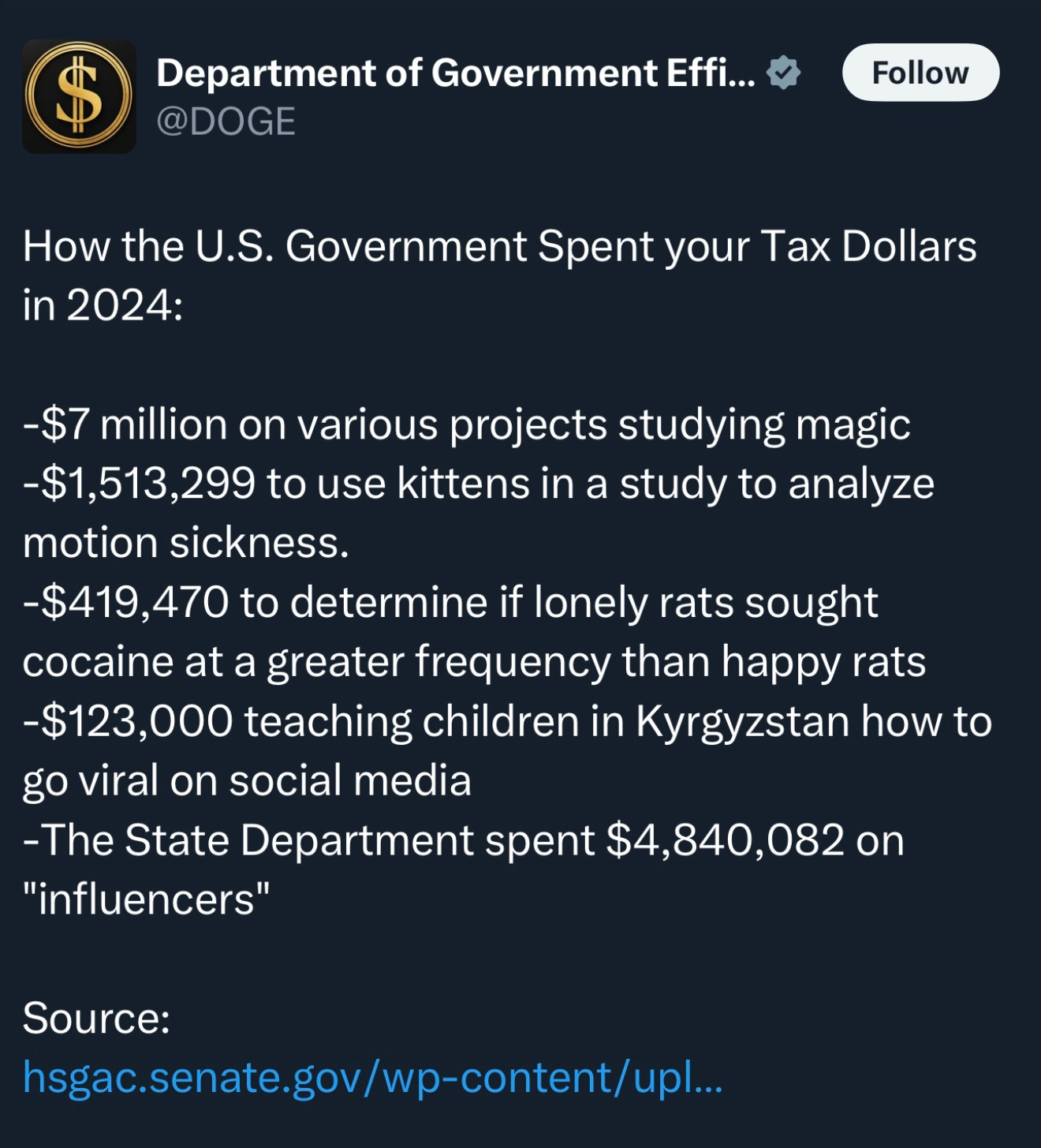
Here is the Department of Government Efficiency (“DOGE”) account — which we will be highlighting more later on — “informing” the public with Sen. Paul’s research.
And here is the former co-chair of DOGE, Vivek Ramaswamy, jumping in to validate how “laughably bad” the spending is.
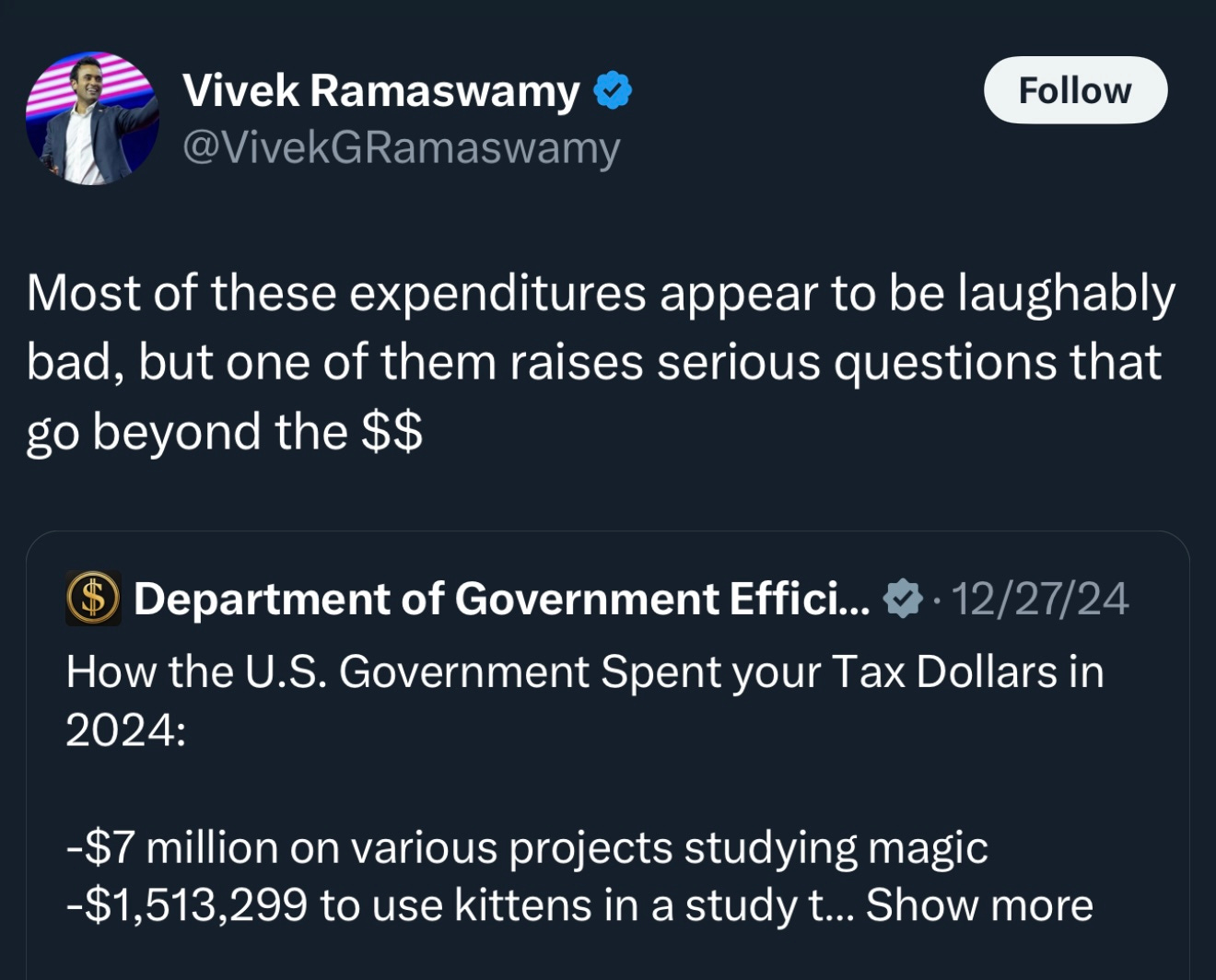
Welp. There ya have it. A United States Senator compiled the research, DOGE tweeted about it, and Vivek Ramaswamy told us it’s laughably bad. It must be true!
What if I told you the “$7 million on various projects studying magic” wasn’t actually about card tricks… Would it interest you to find out that $6,293,820 of that amount is a grant from the Department of Defense (“DoD”) to the Magic City Discovery Center in Minot, North Dakota. Would it interest you to find out that the Magic City Discovery Center is a children’s museum and STEAM-focused education center.1 So yeah, not “magic” in the way DOGE and company wanted you to think about it.
Now here is the question, did they know or were they just willfully ignorant? Honestly I have no clue. One thing people should always consider when engaging with the topic of “what we spend our tax dollars on” is that often there is more to the money madness than meets the eye. I shared this story because DOGE, and their team of super-online couch-potato financial analysts, have been sharing a lot of “deep state corruption” screenshots. They’ve “uncovered the truth!” Yet, as in the example of the Magic City Discovery Center funding scenario, a quick five minutes spent reading Sen. Paul’s report, followed by a review of DoD funding and the receiver of said funding, would educate you on what the money is used for and what the center does. They aren’t funding magic tricks. Alas, “funding magic” sounds ridiculous and, as you’d expect, plenty of folks jumped on board levying attacks on the previous administration’s incompetence.
But look, in the interest of being fair to DOGE, and other self-proclaimed federal budget haters, let’s be clear that not all federal funding — and by extension spending — is good. As an example, President Trump’s Executive Order (“EO”), Ending Radical And Wasteful Government DEI Programs And Preferencing, seeks to terminate “all discriminatory programs, including illegal DEI and ‘diversity, equity, inclusion, and accessibility’ (DEIA) mandates, policies, programs, preferences, and activities in the Federal Government” and to “review and revise, as appropriate, all existing Federal employment practices, union contracts, and training policies or programs to comply with this order.” In practice this EO does not simply end programs — it also ends, or rather seeks to end, the spending associated with said programs.2
I am sure the DEI grifter class is thrilled. My condolences go out to people like Ibram X. Kendi — an individual who oversaw $55 million dollars for the The Center for Antiracist Research, while also firing 19 of the center’s 36 employees in a series of Zoom meetings, all while reportedly taking in between $20,000 and $30,000 per speaking engagement for himself. It’s a tough life for the DEI grift.
And look, I know to some of you out there, DEI programs are basically the cream of the crop when it comes to worthwhile initiatives. I know you hate what President Trump, and the Republican party more broadly, are doing to DEI programs. That said, can I let you in on a secret? Most people don’t care about these programs one way or the other.3 Generally speaking DEI programs are meaningless to them. For employed adults that claim to care, the outlook is not positive for DEI, with trends indicating a growing share of workers say the focus on DEI at work is a bad thing and that their companies pay too much attention to DEI.


In any event, we aren’t here to discuss the merits or lack thereof for DEI programs. In truth, this piece isn’t intended to discuss the merits of any federally funded programs, given the general “worth” of any number of these programs is subjective to most folks. Given that reality, I won’t sit here rambling on about federal spending packages without acknowledging that I, like many if not all of you, have my own personal preferences for how I’d like our government to spend money. Which really brings us to the point of this piece which is that your personal preferences don't trump the Constitution.
I think we are all pretty aware that Congress is responsible for appropriating money — our federal tax dollars — to be spent on any number of federally funded initiatives. That said, if you weren’t aware that Congress holds this responsibility, and given the recent news coverage of Elon Musk’s management of DOGE you assumed the Executive Branch determines how money is appropriated and spent, then let me direct you to the United States Constitution where, in Article I, it provides for our elected representatives, members of Congress, to do the following:
“…have Power To lay and collect Taxes, Duties, Imposts and Excises, to pay the Debts and provide for the common Defence and general Welfare of the United States; but all Duties, Imposts and Excises shall be uniform throughout the United States;”
Hopefully we can agree that Congress indeed holds the power to both (1) take our money and (2) spend it — even if the libertarians among us are screaming in agony. It may also be worth noting the Congressional power to spend money is implied and supported by another clause in Article I which states:
“To make all Laws which shall be necessary and proper for carrying into Execution the foregoing Powers, and all other Powers vested by this Constitution in the Government of the United States, or in any Department or Officer thereof.”
It would be pretty hard to make a law that is necessary and proper if you can’t fund how that law would function or be enforced. In the interest of time and for those interested in a deeper dive, I’d recommend checking out the Congressional Research Service’s work on the Introduction to the Federal Budget Process and Funding Conditions: Constitutional Limits on Congress’s Spending Power.
And look, even if your still doubt Congressional power to collect and spend our money — as the libertarians among us continue to scream — I would at the very least hope you consider how incredibly important of a role Congress plays in the process and why they play that role in the first place. Consider the words of James Madison in Federalist 58:
“The House of Representatives cannot only refuse, but they alone can propose, the supplies requisite for the support of government. They, in a word, hold the purse that powerful instrument by which we behold, in the history of the British Constitution, an infant and humble representation of the people gradually enlarging the sphere of its activity and importance, and finally reducing, as far as it seems to have wished, all the overgrown prerogatives of the other branches of the government. This power over the purse may, in fact, be regarded as the most complete and effectual weapon with which any constitution can arm the immediate representatives of the people, for obtaining a redress of every grievance, and for carrying into effect every just and salutary measure.”
Members of Congress, specifically the House of Representatives, hold a vital role in the functioning of our government. They are the closest to the people, and surely most qualified to represent local concerns to the federal government — despite what MAGA folks keep saying about President Trump’s mandate. Sadly, year after year, they have squandered our money in a variety of ways. In the last 50 years we had a budget surplus only four times. The trend, as we all know and hear about, is that year after year we continue to run massive deficits.
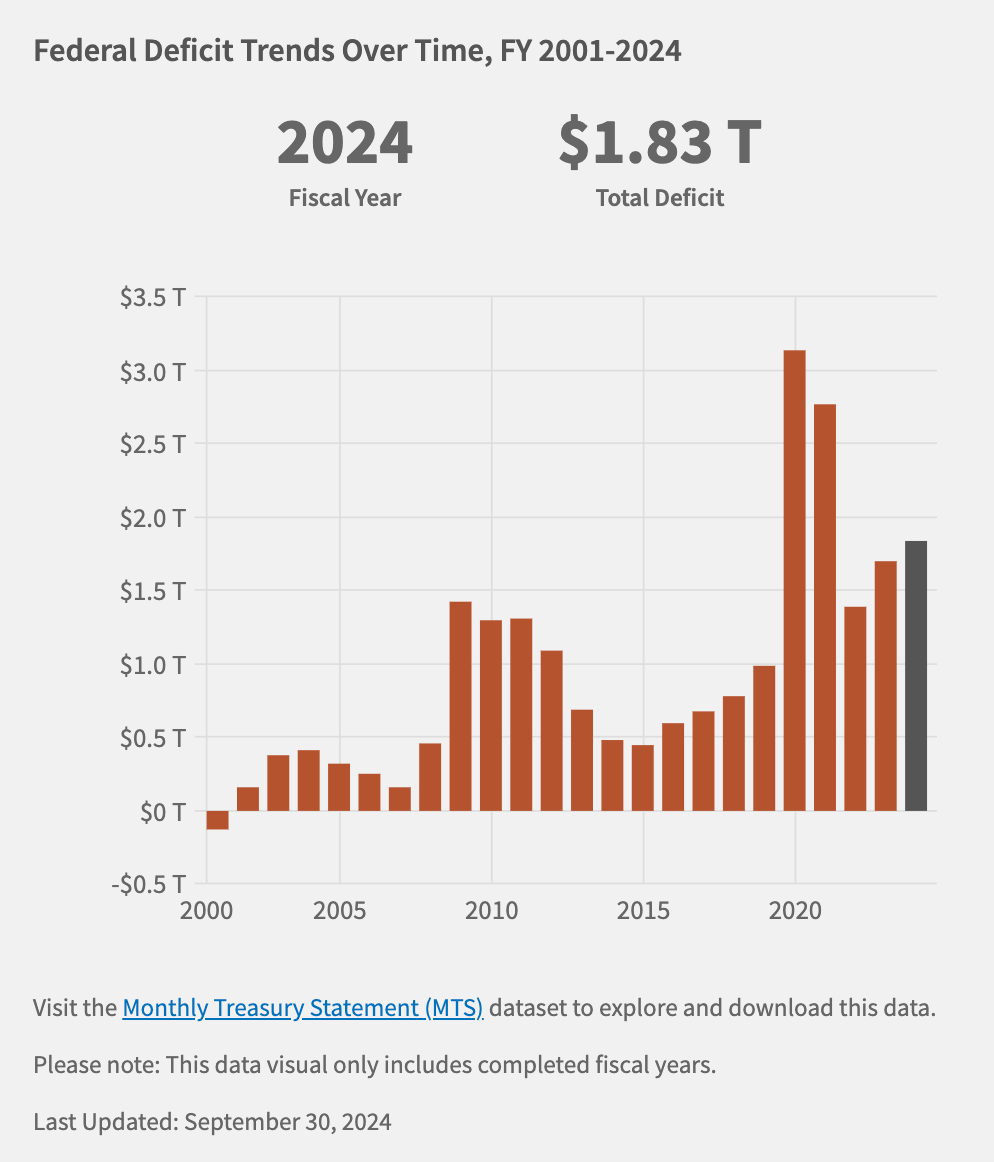
And as our elected representatives continue to pass spending packages that contribute to our trend of deficit spending, our national debt — and crucially the interest attached to our debt — grows at a seemingly unstoppable pace. Consider the graphic below put together by Manhattan Institute Senior Fellow, Brian Riedl (if you want to learn about budget, tax, and economic policy I cannot recommend a better person).4
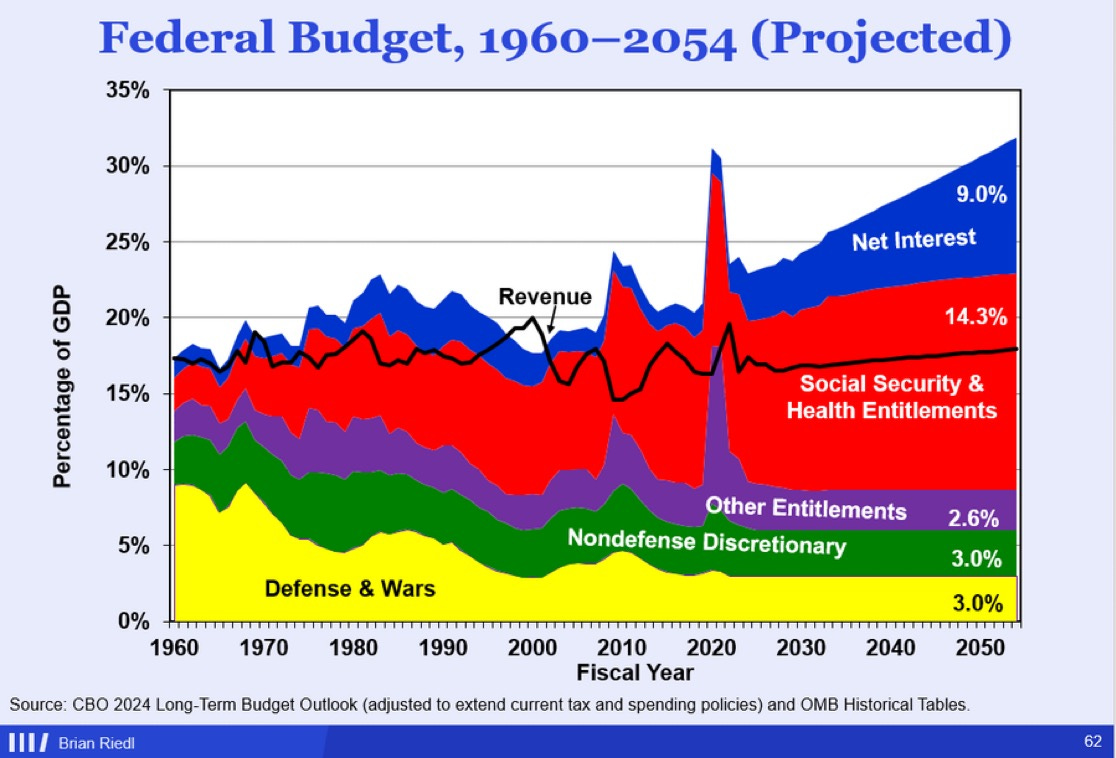
Given the situation we find ourselves in, it’s not surprising Donald Trump adopted the idea of slashing government spending — although his first term didn’t prove to be one of fiscal responsibility (even if you ignore Covid) — and has used his victory to lay claim to a mandate of Unitarian Government control over spending.5 This brings us to the Executive Branch’s role in government spending. Consider the following snippet from Article II of the Constitution:
“He shall take Care that the Laws be faithfully executed.”
Over the course of U.S. history, this clause has been used to debate the power of the Executive Branch to impound Congressionally appropriated funds. So what does “to impound” mean? While there is no constitutional, statutory, or case law definition, it might best be described as an “Executive Branch action or inaction that results in a delay or refusal to spend appropriated funds, whether or not a statute authorizes the withholding.”6 The Impoundment Control Act of 1974 (“ICA”) created procedural means for Congress to consider and review the Executive’s withholding of the budget and, by extension, requires the Executive Branch to promptly report to Congress all such withholdings. Under the ICA, if the President requests the withholding of funds, then the President may defer spending funds for up to 45 days. If Congress does not approve the President’s budget rescission request within 45 days of receiving it, then the funds must be spent.7
The Nixon administration — pre-ICA — withheld funds far more than his predecessors, arguing they were within their rights to impound Congressionally appropriated funds because the President had to “‘consider all the laws’ that bore on fiscal policy (e.g., statutes allegedly bearing on inflation) and accommodate the purposes of these other laws when deciding whether to spend all, or only some, of the funds appropriated for a particular program.”8 Congress on the other hand — back in the day when they weren’t as spineless as our modern-day representatives — argued that Nixon’s actions were, in essence, a line-item veto.9 More on that at the end of today’s piece.
Most recently, President Biden sought to impound funds appropriated for the border wall. House Budget Committee Republicans did not take well to this impoundment. They said, in part:
“President Biden’s public statements and his Administration’s actions make it clear he has every intention on continuing to violate the Impoundment Control Act of 1974 by illegally withholding border wall funding… The President’s disregard for the rule of law is all the more unforgiveable given the national security and humanitarian crisis at the southern border which his Administration has failed to address… President Biden’s refusal to continue building the border wall – with funds Congress has already appropriated – is nothing more than sheer ideological stubbornness, putting the safety and security of the American people at risk.”10
Everything Republicans said about President Biden’s withholding of border wall funding was true. There is little-to-no doubt in my mind the Biden Administration had every intention of disregarding the law simply because they had ideological differences. However, the Government Accountability Office (“GAO”) ruled that the Biden Administration’s decision to halt funding for the construction of the border wall was legal under the ICA because the Administration’s actions constituted “programmatic delays” to conduct “environmental reviews.” As such, the GAO concluded the funds were not withheld for policy reasons.
Now, I know many of you are thinking “that is a load of crap” and, to be fair, you’d be correct. But I want you to read part of the GAO’s reasoning:
“We conclude that neither the Proclamation nor its implementation violate the ICA. Funds appropriated to the Department of Homeland Security (DHS) in previous fiscal years are almost fully obligated on border barrier construction projects. Construction has been suspended for some projects in order to rescope the projects to mitigate environmental damage and minimize the impact on border communities, consistent with statutory requirements under environmental and other laws. Delays in spending these funds in order to satisfy applicable statutory requirements are programmatic delays, not impoundments.”
This is where the Biden Administration differed with the Trump 2.0 Administration. The Biden Administration was willing to play ball under the ICA by seeking legal reasons to withhold or delay spending Congressionally appropriated funds. The Trump Administration is not playing ball, but more on that in a moment. For now, let’s look at Elon Musk and DOGE.
When Donald Trump took office, he signed a flurry of Executive Orders (“EOs”). One of those EOs was the “Establishing and Implementing the President’s Department of Government Efficiency.” This EO effectively renamed the U.S. Digital Service to become the U.S. DOGE Service. The EO provides, in part, the following:
Section 1. Purpose. This Executive Order establishes the Department of Government Efficiency to implement the President’s DOGE Agenda, by modernizing Federal technology and software to maximize governmental efficiency and productivity.
Sec. 4. Modernizing Federal Technology and Software to Maximize Efficiency and Productivity. (a) The USDS Administrator shall commence a Software Modernization Initiative to improve the quality and efficiency of government-wide software, network infrastructure, and information technology (IT) systems. Among other things, the USDS Administrator shall work with Agency Heads to promote inter-operability between agency networks and systems, ensure data integrity, and facilitate responsible data collection and synchronization. (b) Agency Heads shall take all necessary steps, in coordination with the USDS Administrator and to the maximum extent consistent with law, to ensure USDS has full and prompt access to all unclassified agency records, software systems, and IT systems. USDS shall adhere to rigorous data protection standards.
Sec. 5. General Provisions. (a) Nothing in this order shall be construed to impair or otherwise affect: (i) the authority granted by law to an executive department or agency, or the head thereof; or (ii) the functions of the Director of the Office of Management and Budget relating to budgetary, administrative, or legislative proposals.
The “too long; didn’t read” version of the EO is that DOGE is tasked with improving efficiency in the federal government by modernizing our technology and software systems. So what does that look like in practice? Well on February 5th, Secretary of Transportation, Sean Duffy, announced DOGE will help modernize and upgrade our U.S. aviation systems. Who could possibly have a problem with that? That seems to fit the scope of DOGE’s work as laid out by the EO.
The problem is that by and large DOGE is not actually taking steps to modernize Federal technology and software. Rather, Elon Musk and company are going around various agencies of the federal government and straight up cancelling contracts, firing workers, and ending government initiatives.11 They are, by all means, taking an axe to any spending they don’t agree with. Put another way, they are withholding Congressionally appropriated funds but, unlike the Biden Administration, they are not playing the ICA game with Congress.
And look, I get it — many of you are cheering for these cuts and you want more of them. You don’t care about the Trump Administration running around Congress in violation of the ICA. You see, as an example, the “exposure” of USAID — an agency established in 1961 via an EO from President John F. Kennedy and later established as its own agency by an act of Congress — and think to yourself “it’s stupid foreign countries receive Americans’ hard-earned money.” You see reports showing USAID sent millions upon millions abroad for research relating to the coronavirus at the Wuhan Institute of Virology in China, aid for LGBT rights, and migrant crises in other countries, and become frustrated and feel forgotten. Congress failed you and President Trump is saving you.
You are mad and justifiably so. You may feel, as many Americans rightfully do, that we ought to help ourselves before sending aid to other countries. You also may feel — and it appears to be quite the popular position on social media channels among MAGA types — that aid should should simply never go to other countries. It isn’t just “America First” it’s “America Only.” Although that mindset seems to contradict what President Trump is pursuing now on the Gaza Strip (see image below). Shouldn’t we build “beautiful communities” in the U.S. — such as in North Carolina — before we care about what happens in the Middle East? That is what I’ve been told…

In any event, I understand your frustrations with foreign aid spending — I believe by and large there is a lot of necessary work to be done to correct years upon years of aid mismanagement. That said, I believe “cutting all aid” is a bad idea. As an example, I don’t mind saying I believe it’s tragically idiotic to cut PEPFAR, a program that for a mere 0.1% of our federal budget has saved over 25 million lives. I know conservative, rage-bait commentators like Matt Walsh feel differently, but then again their pro-life stance only extends as far as the grift will benefit them — and children in Africa don’t benefit Matt.
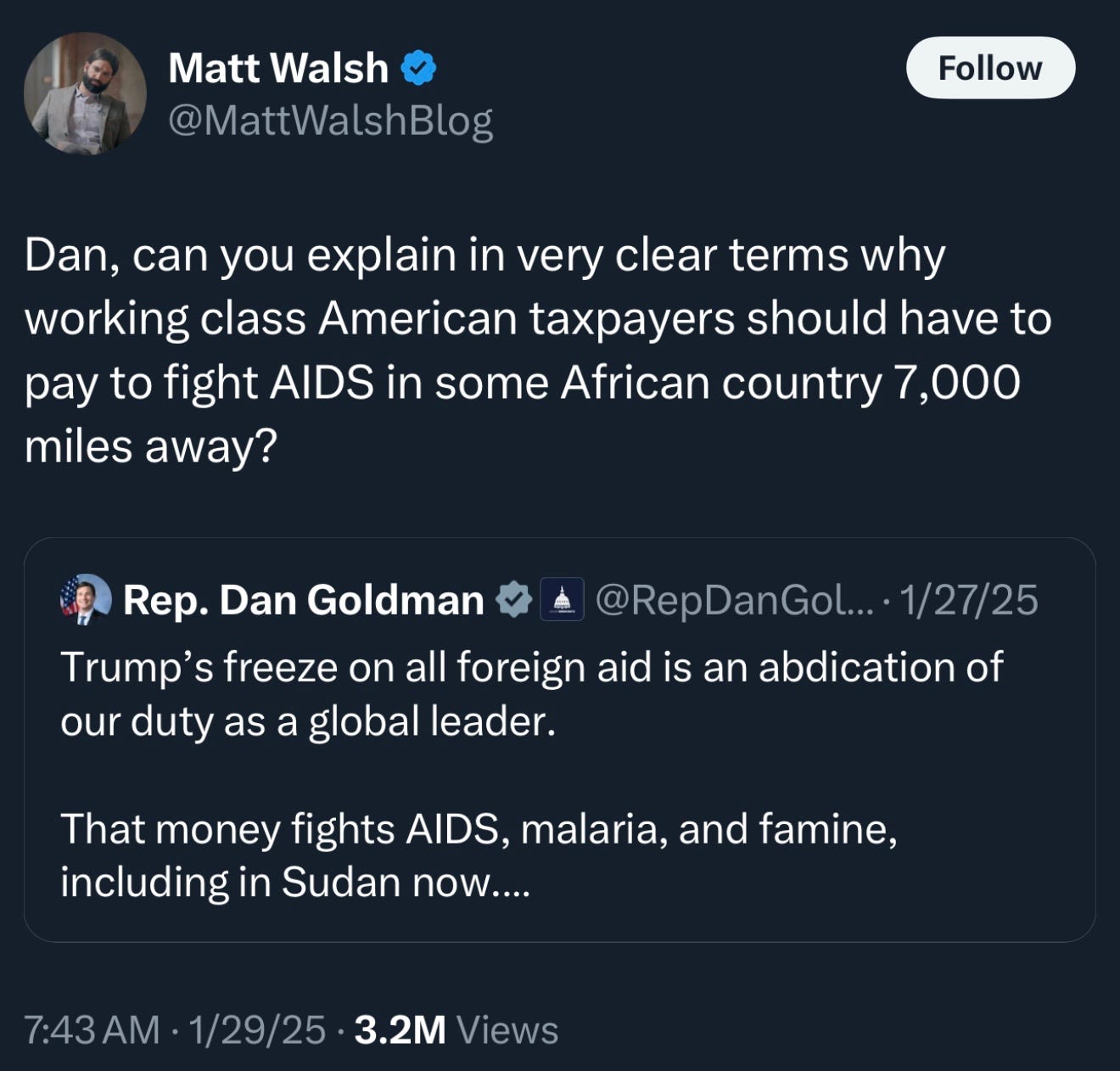
In any event, I think it is worth noting that Secretary of State, Marco Rubio, as recently as 2017 agreed with me (or maybe I with him?) on the topic of Foreign Aid.
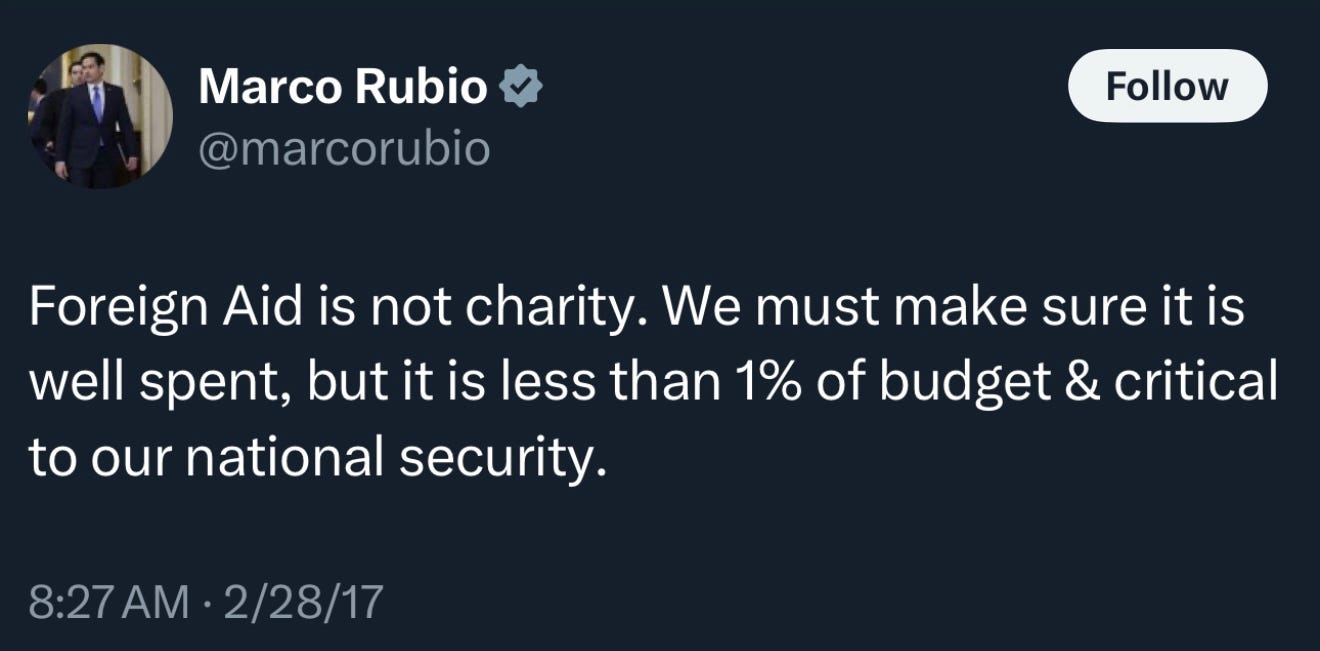
We should be diligent, carefully considering how our money is spent. In my opinion, I think people get so heated about this topic — beyond that of simply finding what appears to be egregious spending judgments by USAID — because they think foreign aid is some massive chunk of our budget. Would it surprise you to find out it isn’t? In fact, foreign aid is effectively “budget dust” in the grand scheme of things.
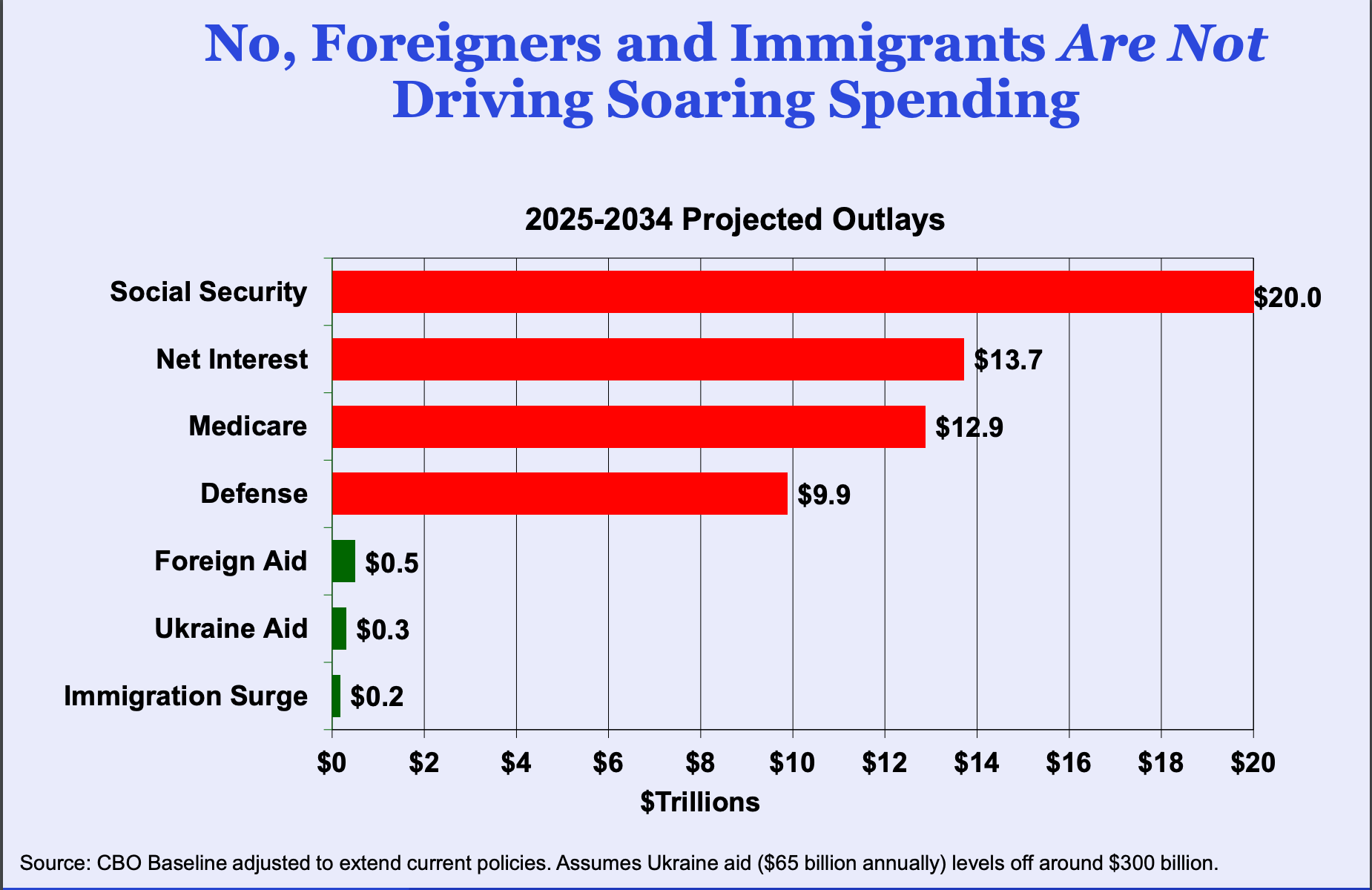
But let’s get back to DOGE before we get too off track. DOGE was tasked, according to the EO, with a pretty technical mandate to modernize federal government systems. It takes quite the stretch when reading the EO to make it provide for slashing funding across the board as it — or should I say, Elon — sees fit. Even if the EO provided Elon with authoritative powers to slash spending, there is no mechanism by which he can do that for policy reasons which would stand under current legal precedent (i.e., enforcement of the ICA). Which brings us back to the words of Alexander Hamilton I placed at the top of this piece.
“The Executive not only dispenses the honors, but holds the sword of the community. The legislature not only commands the purse, but prescribes the rules by which the duties and rights of every citizen are to be regulated.”
Today I am afraid we find ourselves in a situation where neither the Executive or the Legislative Branches care to uphold or restrict their duties to what the founders intended or what our laws require of them. Instead we have an Executive — and this has been the case for several terms now across both Republican and Democratic administrations — that sees itself as an administrator of both form and function. We have a Congress that sees their role not as legislators representing the needs of their districts and states, but rather arbiters of rage bait — always seeking to entice a political fight, rarely seeking solutions to our common problems. We have Courts, that as Hamilton once said, have neither “FORCE nor WILL, but merely judgment” and are surely being placed in a position where their judgements will be tested and likely ignored.
As we come to a close I want to be clear in that I don’t have a solution to this mess — at least not one people seem ready to jump on board with. So instead let me leave you with some food for thought as we revisit the line-item veto power I told you we’d get to at the end of our time together today.
The line-item veto, in practice, would allow a President to extract and in essence, veto, individual items in an appropriations or substantive bill. In 1996 Congress passed, and President Clinton signed, the Line Item Veto Act. The law enabled President Clinton — and all those who would come after him — to cancel certain items in spending packages or tax benefits. To do so, the President would need to determine the cancellation would (1) reduce the Federal budget deficit; (2) not impair any essential Government functions; and (3) not harm the national interest — all things, might I add, that President Trump is seemingly trying to do. The Supreme Court held the Act was unconstitutional because it violated the Presentment Clause.
I bring this up because the Trump Administration is attempting to — and quite frankly getting away with — the use of a post hoc line-item veto. Many of the funding initiatives Elon and DOGE are cutting were appropriated by the last Congress and signed by President Biden. It is a blatant violation of constitutional norms to allow a President unilateral power to decide he doesn’t like certain spending and as such he is just going to get rid of it. Outside of spending, President Trump has taken this “post-hoc line-item veto” approach to the TikTok “ban” where he plainly said, in response to not enforcing the law, “I think we have bigger problems” (go check out my piece The Good, the Bad, and the Unserious for more details). He does not care that the previous Congress passed the law. He does not care it was signed by President Biden. He disagrees with the law for personal reasons, and as such, has determined he has no desire to enforce it.
Do you still disagree with me that what he is doing is a blatant violation of constitutional norms? Then consider this as we close. I want you to imagine that in three years time, towards the end of President Trump’s term, Congress passes and President Trump signs, a spending package that provides hundreds of millions of dollars to crisis pregnancy centers. For those that don’t know, these centers are hailed by the pro-life community as good and much needed resources for desperate mothers. These centers advocate pro-life policies and certainly have been effective at preventing abortions. If they weren’t, the left probably wouldn’t hate them as much as they do.
I want you to imagine a Democrat wins the next Presidential Election and takes a seat in the oval office, pen in hand ready to sign a flurry of EOs just as President Trump has done. What stops them from ignoring the will of Congress and the former President? What stops them from withholding funds, as in the case of Presidents Nixon or Biden? What stops them from not only revoking funding from pro-life causes but effectively shutting down these organizations? You who cheer in the present are certainly doomed to resent the past.
Consider this short clip from the 1966 film, A Man for All Seasons. Many thanks to a former professor of mine, Dr. Warf, for sending this to me when we were discussing this topic. I think it fits nicely.
So I leave you with this question — where will you turn when all the laws lie flat?
Until next time…
STEAM education is an approach to learning focused on Science, Technology, Engineering, the Arts and Mathematics.
From the EO: (b) Each agency, department, or commission head, in consultation with the Attorney General, the Director of OMB, and the Director of OPM, as appropriate, shall take the following actions within sixty days of this order: (i) terminate, to the maximum extent allowed by law, all DEI, DEIA, and “environmental justice” offices and positions (including but not limited to “Chief Diversity Officer” positions); all “equity action plans,” “equity” actions, initiatives, or programs, “equity-related” grants or contracts; and all DEI or DEIA performance requirements for employees, contractors, or grantees.
A Monster Workplace Poll found that 72% of workers say that personally, DE&I is not very important to them (8%), or not important to them to them at all (64%). 58% of workers think that the DE&I efforts currently in place by their employer are not effective at all and have resulted in no meaningful change.
I highly recommend folks check out Brian Riedl’s piece at the Manhattan Institute, A Comprehensive Federal Budget Plan to Avert a Debt Crisis.
A Unitarian Government is a system of political organization in which most or all of the governing power resides in a centralized government, in contrast to a federal state.
From the Constitution of the United States of America: Analysis and Interpretation ("Constitution Annotated" or "CONAN"). This resource is described as providing “a legal analysis and interpretation of the United States Constitution based on a comprehensive review of Supreme Court case law and, where relevant, historical practices that have defined the text of the Constitution.”
I thoroughly enjoy using this resource and recommend it as an “on the go” version of the Constitution.
See the Center on Budget Policy and Priorities FAQs on Impoundment for more information and helpful explanations.
A line-item veto is an unconstitutional veto over specific portions of an appropriations or substantive bill.
The Impoundment Control Act essentially prohibits the Executive Branch from withholding Congressionally appropriated funds for policy reasons.
This footnote was added post-publishing in response to a reader who submitted a question. The reader asked, “isn’t the media misconstruing what DOGE is doing? It was my understanding that spending for groups like USAID has been frozen, not that these line items have been terminated. Isn’t it okay for them to freeze funds while they review or investigate the department?”
This is a super important question . Admittedly I should have found a way to write this piece in a structure that spent more time diving into the review/investigate processes during a “freeze.” There are indeed instances where, if you take Elon, DOGE and company at their word, that you would rightfully assume they have outright cancelled spending. They have said as much on multiple occasions. It is also difficult to keep track of what is true or not, given even the White House and Republicans more broadly are confused about if funds were frozen or still flowing. In any event, most often it appears DOGE and company have outright cancelled spending as it relates to DEI initiatives (e.g., staff, trainings) and lease agreements.
In the example of DEI initiatives, while many people — myself included — believe these initiatives are a waste of government funding, it still stands that Congress appropriated money to be spent across a wide range of discretionary areas. It stands the proper course of action would be for the Executive Branch to report to Congress that certain funds are no longer necessary to carry out the goal(s) of the government. If Congress approves, then that money could be diverted elsewhere or not spent.
In the example of lease agreements, the government, while in their right to determine a space may not be reasonably necessary to carry out the work of the federal government, has other issues in that it may violate general contracting agreements. DOGE cannot simply cancel contracts previously agree to with no repercussions. Going back to the Executive Branch’s determination that it may not need a space to carry about the work of the federal government, the proper order of things would be to submit a report to Congress that X amount of funding is no longer necessary. While many people feel we should drastically cut down on “unused office space,” it would be good to consider that the “return to office” mandate by President Trump will result in the federal government’s need for office space. These cuts are premature and may put the federal government in a predicament when it is all said and done.
As to USAID funding, President Trump’s EO “Reevaluating and realigning United Stated Foreign Aid” places a straight up 90-day pause on all “foreign development assistance for assessment of programmatic efficiencies and consistency with United States foreign policy.” This notably goes beyond the ICA which allows a pause for 45 days. Further, rather than conducting reviews prior to the freeze, the freeze was announced first — and in a way that caused mass confusion — and then the reviews are scheduled to occur. A proper way to do this would have been for the Trump Administration to notify Congress of their intent to review all foreign aid expenditures to ensure alignment to the strategic goals and initiatives as stipulated by Congress and in conjunction with the foreign policy goals of the United States. This isn’t what happened. The Trump Administration has strictly “policy” differences with foreign aid — as evidenced during the campaign trail and the “America First Movement” — and it is for that reason, and that reason alone, that the Trump Administration has frozen the funds.